Ask why the run failed. Get the cause and whose it is.
Pipewright Assist is an assistant for pipeline incidents, new in 1.4.4 as a preview. Ask it in plain words why a run failed. It answers with the step, the recorded cause, whether it is your team’s to fix or the platform’s, and the next thing to do. It reads no data rows, changes nothing and keeps a record of every answer.
Why did the latest churn training run fail, and who needs to fix it?
screenModel Armor: the question is cleanguardrunschurn · failed at record-metrics · recorded causefactsknown_fixrule: permission · owner: platformfixed liststep logs, rowsnever read: not in Assist’s toolsdataA failed run starts a search. Assist ends it.
When a training run fails at 2am, the morning goes on the same detective work every time: which step, what error, is it our code, our data or something the platform did not provide. Pipewright already knows most of the answer. Since 1.4.4 it records the cause with every failed run; Assist puts it in front of the person who asks, in plain words.
What a failure costs today (before anyone fixes anything)
Consoles, step logs, the pipeline graph, the release that ran. The search is the same every time, and it takes a skilled engineer away from the work.
A missing permission, a quota, a service perimeter: a team can lose a day before learning the cause was never theirs to fix.
One refused permission is a ticket. The same refusal across three teams is a platform fault, and today nobody adds them up.
Faster recovery, the right owner first time, and an assistant risk can say yes to.
Assist is built for the costs a platform carries quietly: engineers’ time on diagnosis, days lost to failures sent to the wrong team, and AI tools that security will not let near production. The preview runs in your own Google Cloud project, at Google’s prices, and is off until you switch it on.
The cause in the time it takes to ask
The step, the error’s type, the line that raised it, the data contract that failed: recorded by Pipewright when the run failed, shown when you ask. No console, no log search.
Every answer names an owner
Your team, the platform team, or “unclear” when the facts do not say. A refused permission goes to the platform the first time, with the Terraform to change; a broken contract goes to the team, with the setting to change.
The platform sees the week
“Which failures this week were platform causes, and which use cases are blocked right now?” One question, every team in the environment, counted by owner.
Safe to say yes to
It never reads data rows, feature values, predictions or step logs, and it cannot run, release, approve, deploy or grant. Questions and answers go through Google’s Model Armor, and every answer is recorded.
Tested on real failures
Before release, Assist answered 22 recorded failures three times each against the real model: 66 of 66 correct, with the owner and the cause matching the record every time, and no confident wrong cause.
Small and predictable cost
About 2,800 to 3,500 tokens an incident question on gemini-3.8-flash, billed to your project by Google. A ceiling per question stops a runaway; Enterprise adds a budget per team.
| Who | Beforea failed run | With Assistthe same run |
|---|---|---|
| ML engineer | Reads consoles and guesses whether the failure is theirs | Asks, and gets the cause, the evidence, the owner and the setting to change |
| Platform engineer | Learns of platform faults one ticket at a time | Asks which teams are blocked and which failures were platform causes, before the tickets arrive |
| Head of data or ML | Engineers’ time goes on detective work | Faster recovery and fewer days lost to failures sent to the wrong team |
| Risk and security | Wary of AI near production | An assistant that reads little, changes nothing and records everything, inside your own project |
The facts come from Pipewright. The model only explains them.
A language model is good at finding the run you mean and saying what happened in plain words. It is not trusted to decide the cause or the owner. Those come from Pipewright’s fixed rules, the same rules that write the run.failed event, so the answer cannot differ from the record, whatever the model says.
# written by a hook in the step's image, no values from the data
step        validate-data
kind        pipewright_error   # or the team's code, a Google error
where       validate.py, line 43
message     tenure_months: 715 values below 0
rule        checks             owner  team
# the launcher's hourly check publishes run.failed with this cause
Switch on monitoring.failure_records and every failed step leaves a value-free record: the step, the error’s type, the line that raised, check results and Pipewright’s own messages. Without it, Assist can only say “read the logs”. A run the orchestrator refused to start is recorded too.
$ pipewright assist ask "..." --env test --usecase churn
platform switch   allowed for the environment
team switch       churn: assist.enabled, understood 1.4.4
question          sorted: incident, later, action or unrelated
Model Armor       the question, each tool's text, the answer
matched           not sent to the model: ask it in other words
Two switches, both off by default: the platform allows Assist for the environment, and each team opts in after reading the explain page. Questions about anything other than incidents get a fixed “not covered in the preview”, with the command that has the facts today.
> runs       the use case's recent runs and recorded causes
> release    which release ran, and its settings
> checks     the environment checks doctor runs
> known_fix  the fix for a rule, from a fixed list

never        data rows, feature values, predictions, step logs,
             monitoring results, audit logs, the cluster
Text a tool returns is treated as data, never as an instruction, so a planted sentence in an error message cannot steer the answer. A team can only read its own runs. A question gets at most 8 tool calls and 40,000 tokens.
which run, step, state   Pipewright
Cause                    Pipewright, from the recorded cause
Owner                    Pipewright's rules, as in run.failed
Next, Where              the fixed list of fixes
a short explanation      the model; dropped whole if it names
                         a role, an address or a link
A unit test has a “lying” model claim the opposite owner and cause, and checks that none of it reaches the answer. When the facts do not name a cause, the answer says “unclear” and where to look. It does not guess.
open source   .pipewright/assist-log.jsonl in your repository
Enterprise    ai_assist_answers in the evidence dataset (EV-19)

asked by      ana@example.com
run, rule     rfd0bbbf487b9 · checks · owner team
model         gemini-3.8-flash, temperature 0
tokens        3,485          screened  yes
The answer ends with the tool calls and tokens it used, and whether it was screened. Assist quotes no price of its own: your project pays Google at Google’s published prices.
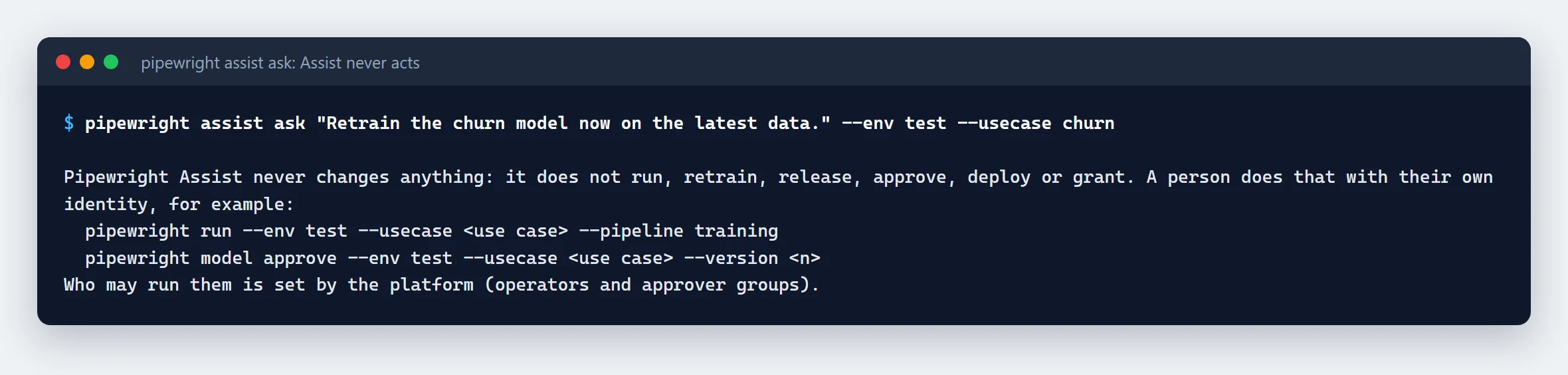
Captured from live runs. Only the project names changed.
Every screenshot below is what the command printed during the 1.4.4 tests, on the open-source starter (Agent Platform) and on Enterprise (private GKE, Kubeflow, a service perimeter enforced). Project names and addresses are replaced with examples. Select a picture to see it full size.
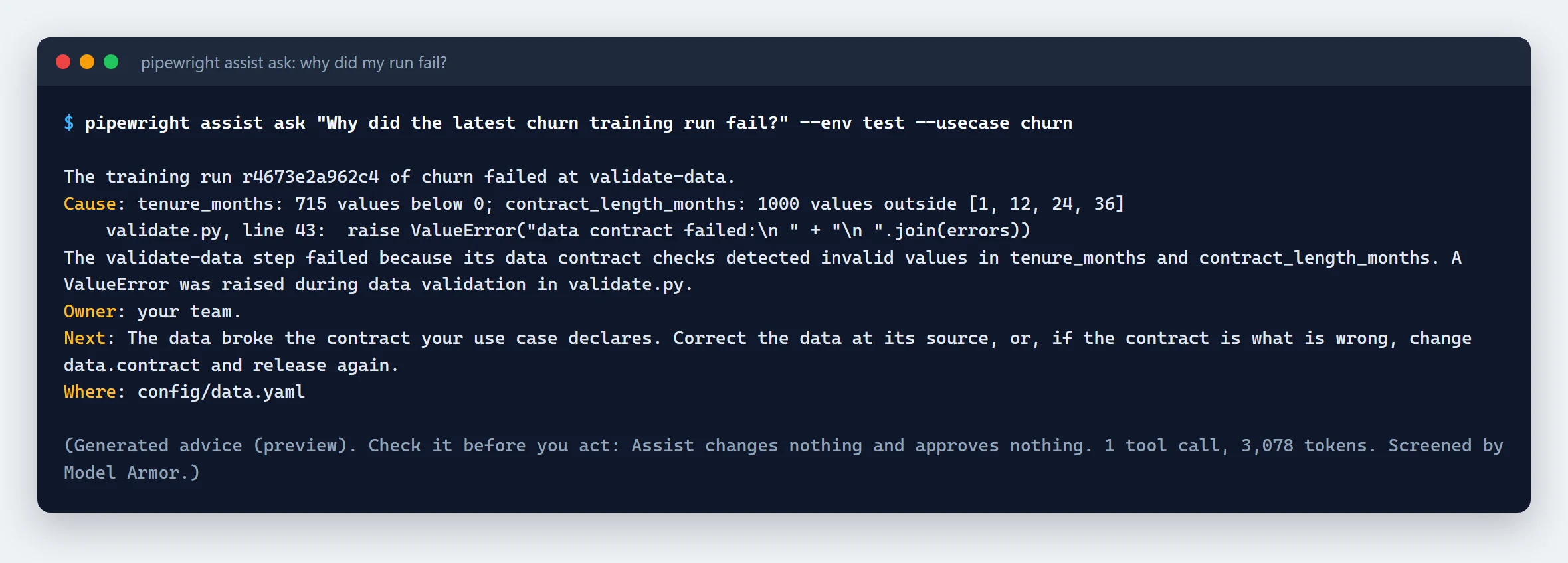
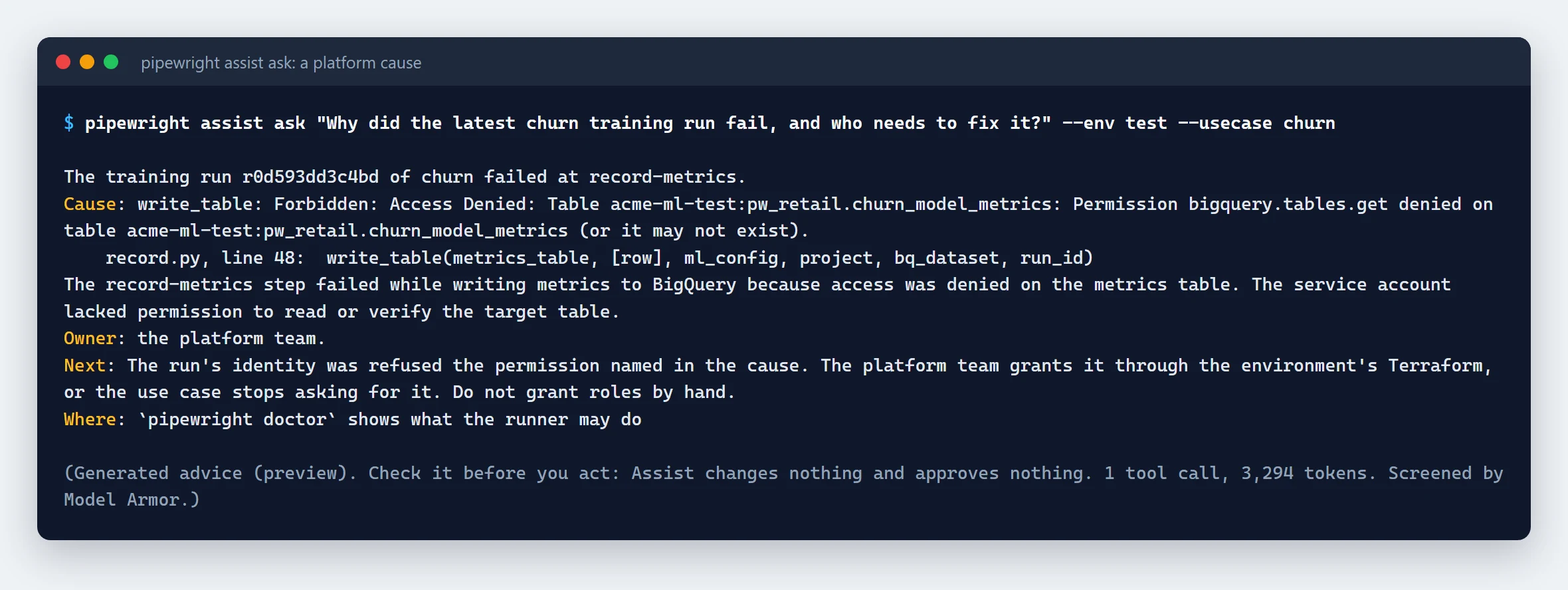
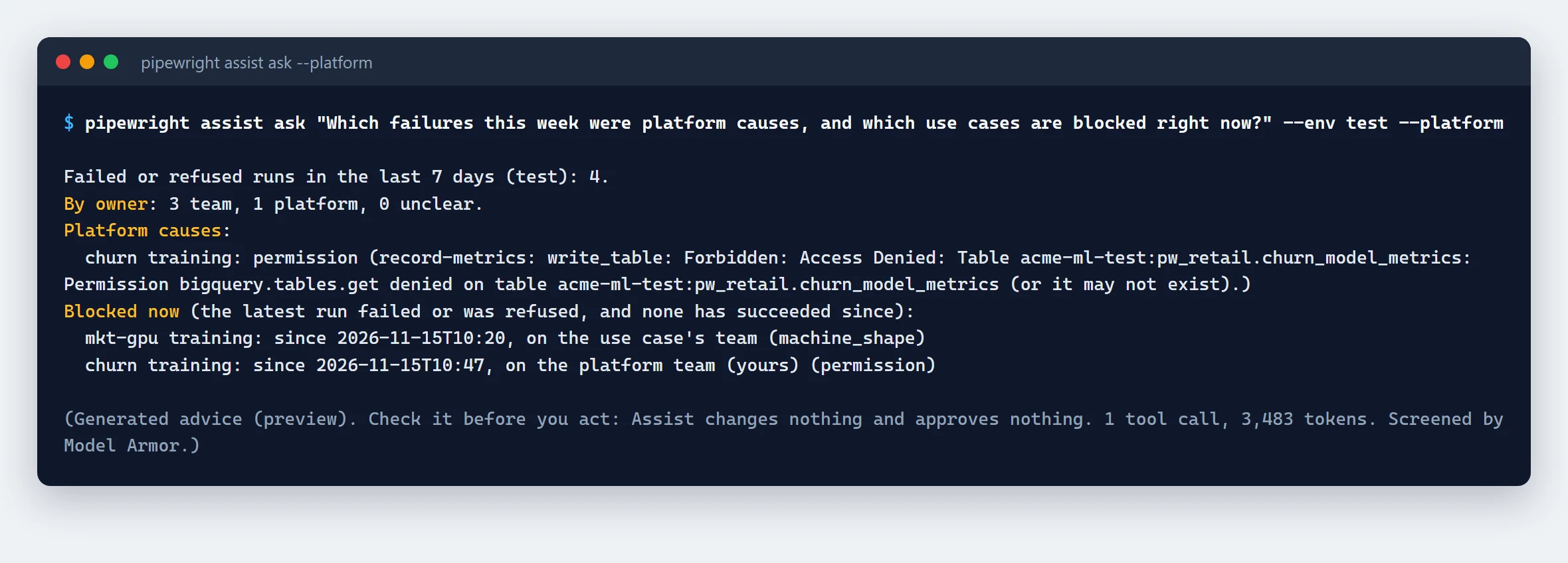
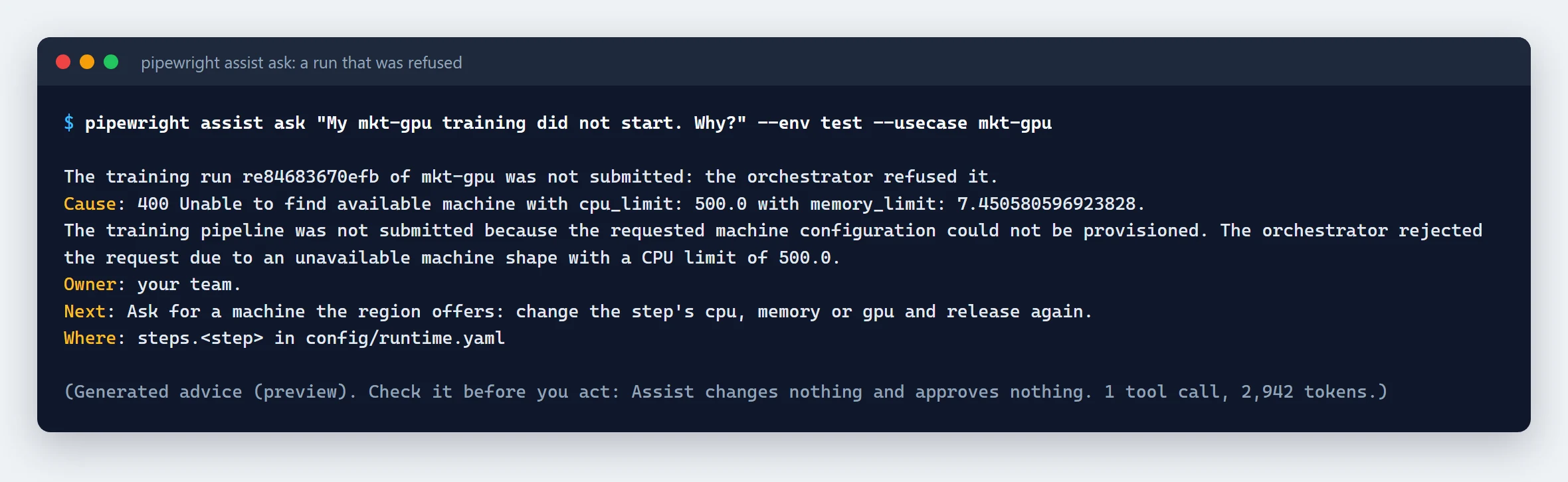
config/runtime.yaml.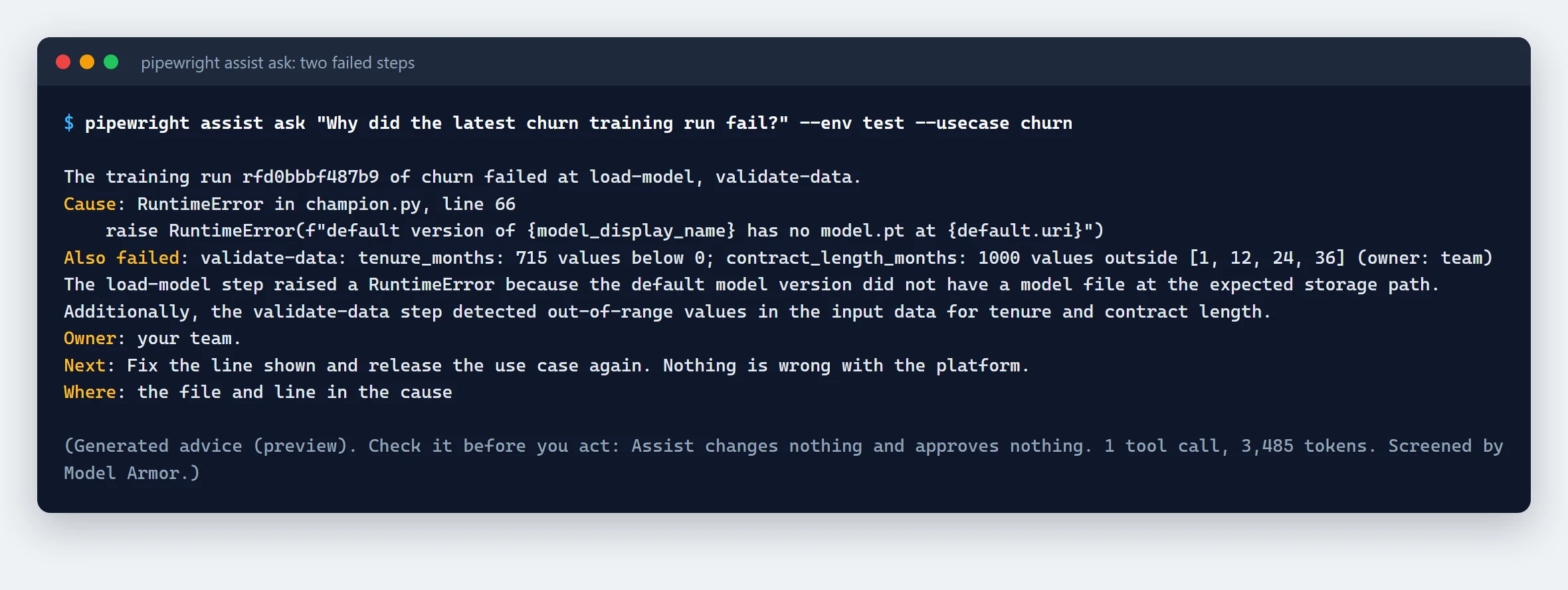
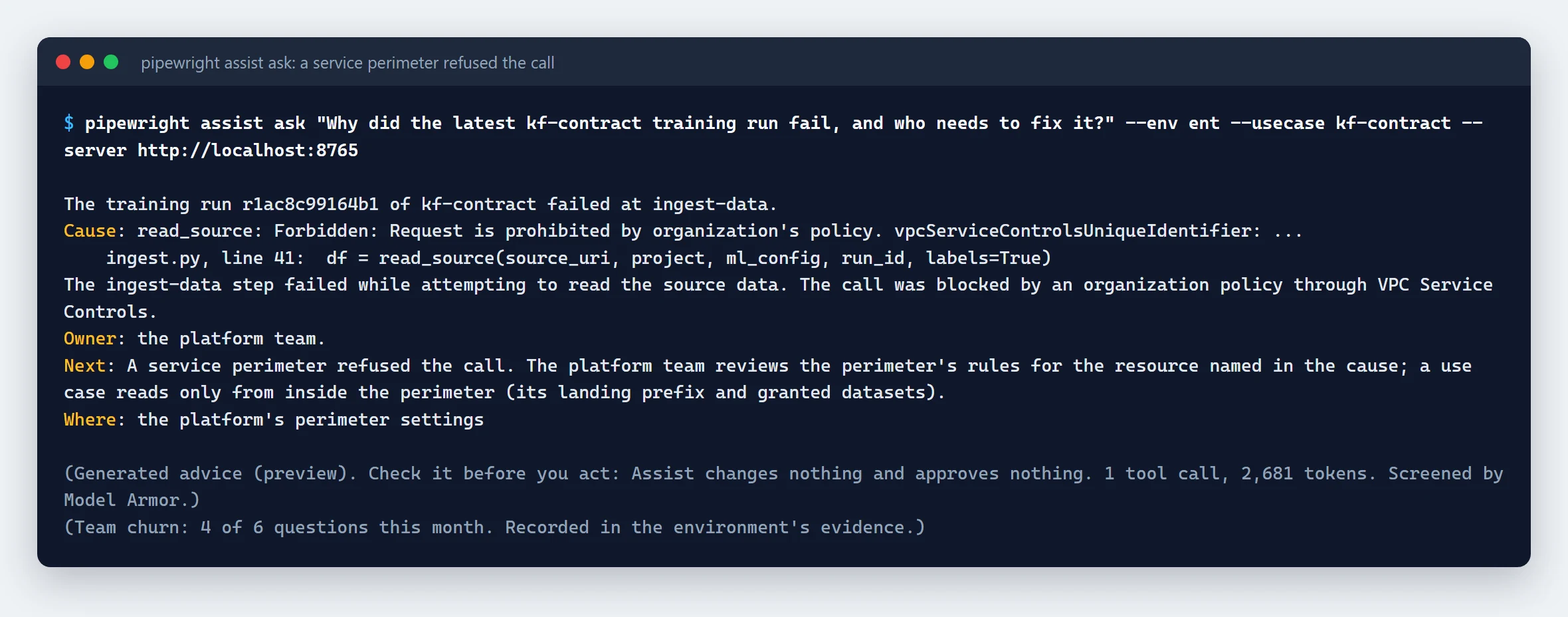
The limits, shown (what it will not do is part of the product)

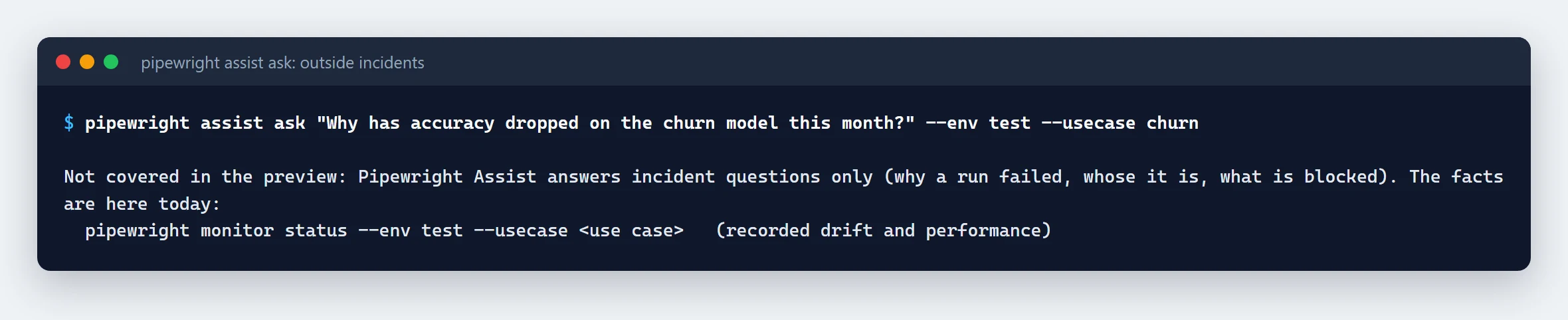

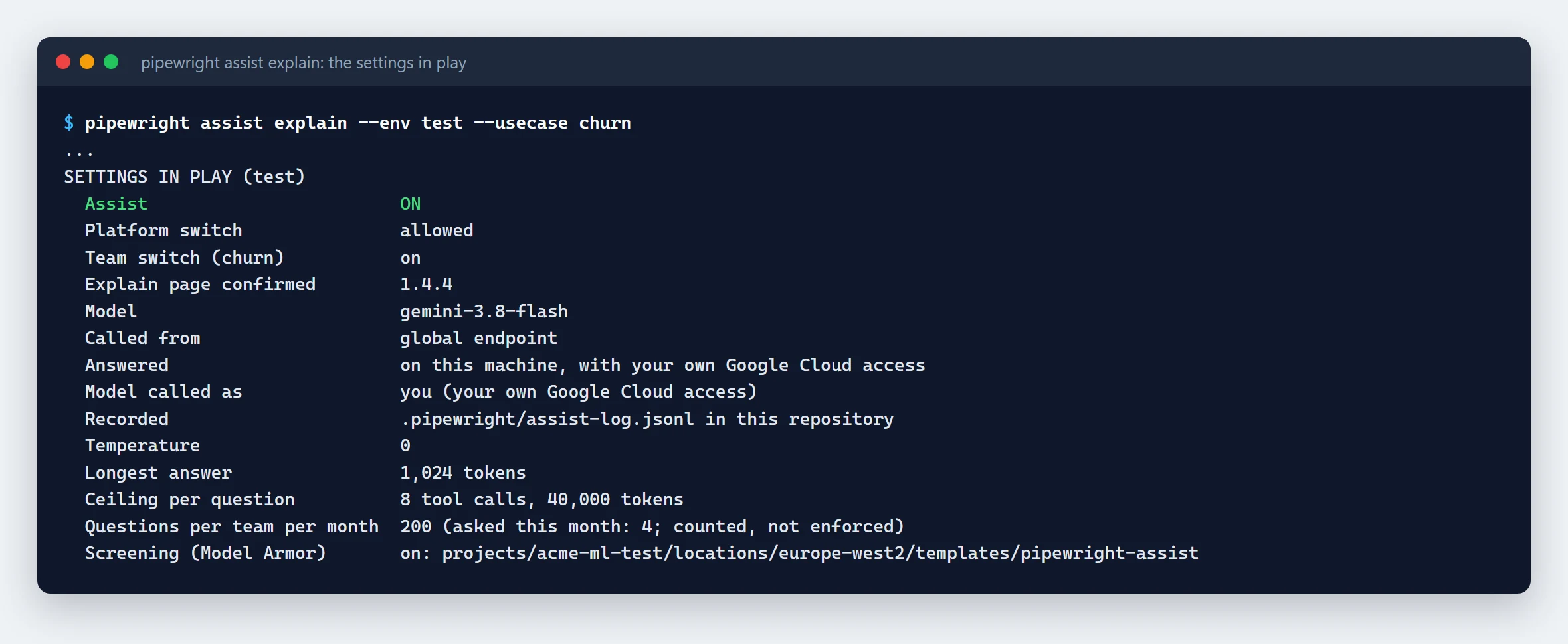
assist explain ends with the settings in play. Read the whole explain page.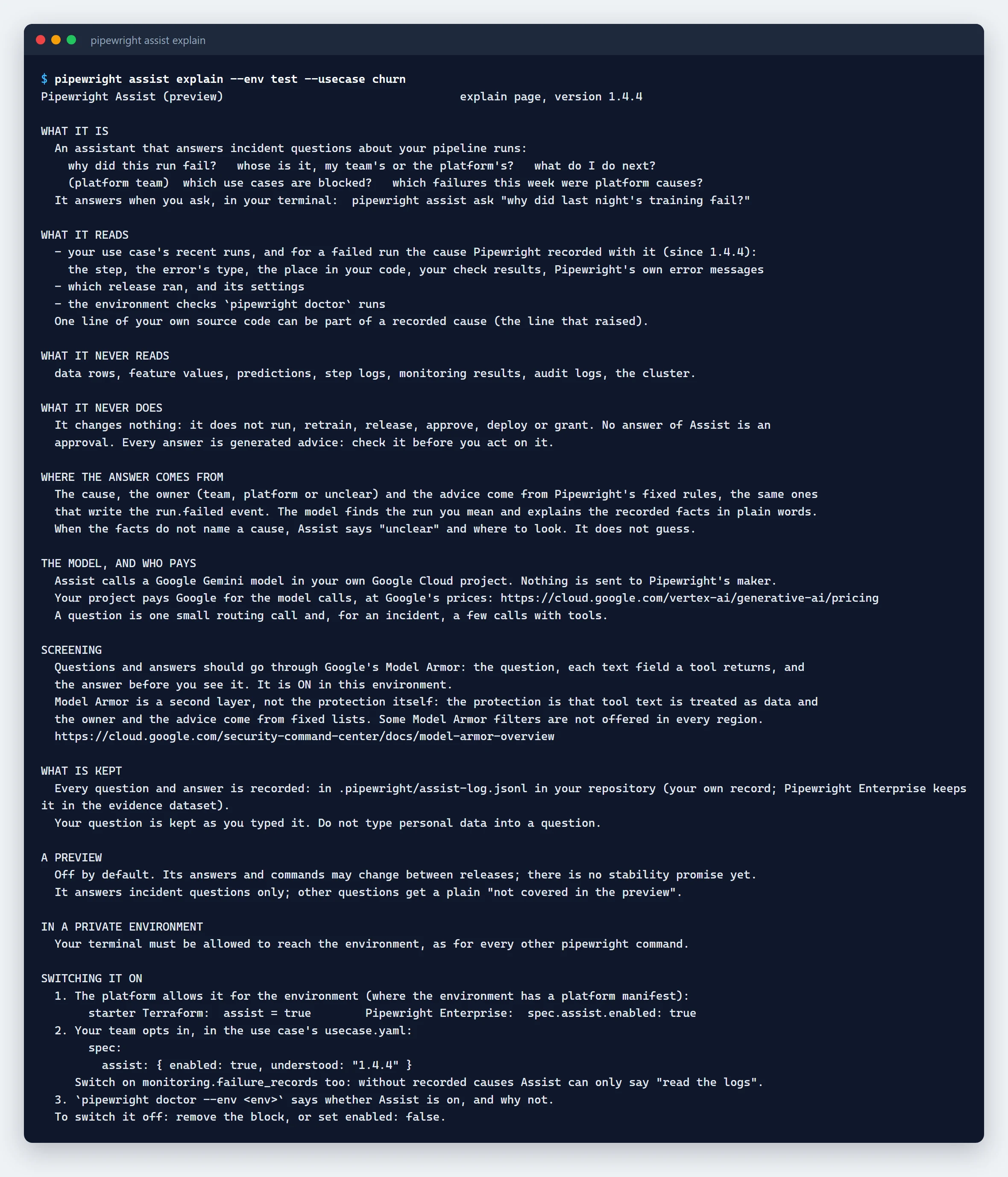
Free to use. Governed where it has to be.
The assistant, its rules, its screening and its test runner are in the open-source core. Pipewright Enterprise answers inside the environment, as its own identity, with a budget per team and every answer in the evidence.
Answered on your machine
pipewright assist ask runs in the engineer’s terminal with their own Google Cloud access, so it can never read more than they can. The record is kept in the repository.
The cause recorded
The failure hook in every step image, the owner rules and the run.failed event with a cause, rule and next step. Useful on its own, with or without Assist.
A test you can run
pipewright assist test replays 22 frozen failures against the model your environment uses, and fails when an owner, a cause or a fix is wrong.
Answered inside the environment
The hosted tool server answers on Cloud Run or private GKE, as an Assist identity nobody can impersonate, behind the service perimeter.
A budget per team
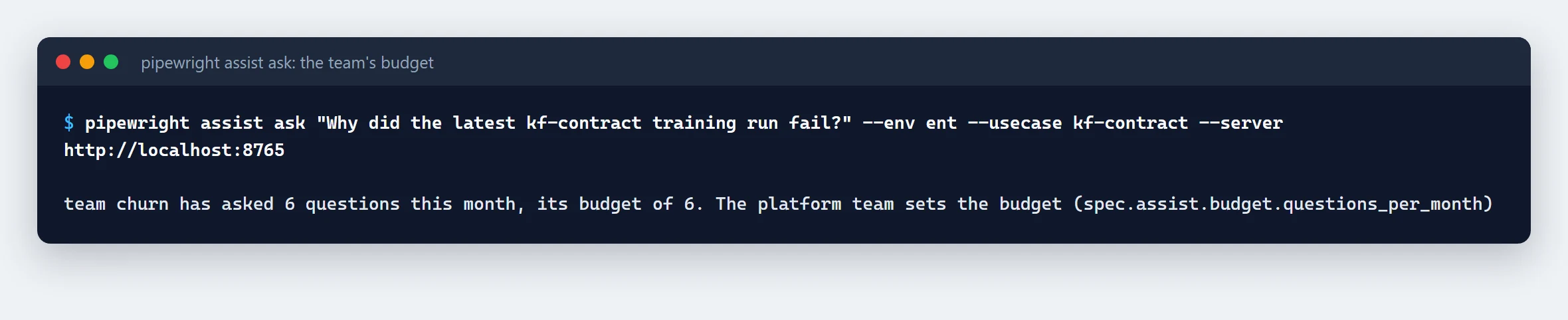
spec.assist.budget.questions_per_month: the platform sets how many questions each team may ask, and the next one is refused.
EV-19 in the evidence
Every answer is a row in ai_assist_answers: who asked, the run, the rule, the owner, the model, the tokens, whether it was screened. The evidence pack gains EV-19.
Two switches. Both off until you set them.
A preview: off by default, incident questions only, and its answers and commands may change between releases. Nothing about your existing use cases changes when you upgrade to 1.4.4.
# the open-source starter
assist          = true
failure_records = true      # the cause recorded with each failed run

# Pipewright Enterprise, platform.yaml
spec:
  assist:
    enabled: true
    budget: { questions_per_month: 200 }
The platform also chooses the Model Armor template. Model Armor’s first 2 million tokens a month are free, then Google charges per million; see Google’s pricing.
$ pipewright assist explain --env test --usecase churn
# what it reads, never reads, never does; where answers come from;
# the model and who pays; screening; what is kept

spec:
  assist: { enabled: true, understood: "1.4.4" }
  monitoring:
    failure_records: true
understood names the explain page’s version: when a later release changes what Assist reads or keeps, the team reads it again before Assist answers.
$ pipewright doctor --env test
ok   Pipewright Assist: on for churn (preview)

$ pipewright assist ask "why did last night's training fail?" \
    --env test --usecase churn

$ pipewright assist ask "which use cases are blocked?" \
    --env test --platform
The model is gemini-3.8-flash on Google’s global endpoint, at temperature 0, called in your own project; nothing is sent to Pipewright’s maker. See Google’s model prices.
The next failure, explained in one question.
Pipewright Assist is a preview in the open-source core from 1.4.4. Enterprise answers inside your boundary, with a budget and the evidence.