Private by default. Evidence for every model.
Everything in the open-source core, plus what larger organisations ask for around it: an environment with every guardrail on, an evidence pack for every model, one view across every environment and team, governed synthetic data, and the people who build Pipewright beside you.
| Use case | test | prod | Evidence |
|---|---|---|---|
| churn | v10 | v2 | |
| lapse-risk | v7 | v4 → v5 | |
| demand-forecast | v3 | v1 | |
| segments | v2 | v2 |
An environment with every guardrail on, from one platform file.
The private-managed blueprint is Terraform your platform team runs in your organisation. Teams join it by name. Nothing in it is reachable from the internet, and the same YAML runs on Agent Platform or on private GKE.
Encrypted, private, guarded
A key per service, rotated; an internal launcher; Private Service Connect; VPC Service Controls and organisation policies on. Pipelines, models and endpoints run in your project, encrypted with your keys.
Approver groups, provisioned
The platform file names the groups, their members and what each must approve. Membership is checked by Google Cloud IAM, never by the model team.
Keyless CI, admitted by identity
GitHub Actions through Workload Identity Federation, let through the perimeter by identity, never by key.
Feature governance
Feature datasets granted per team, features required where it matters, and evidence of every read.
Across private projects
Grants, perimeter rules and proof that the model arrived in production unchanged, byte for byte.
Ray, GKE and your SIEM
Ray provisioned with its private network, keys and identities from one switch; logs and events exported to your SIEM and observability tools.
Fifteen questions, answered for every model.
Each control states what was checked and the facts it rests on: the job, the key, the identity, the approval, the decision. When a source cannot be read, the pack says so.
EV-01Model artifacts encrypted with a customer-managed keypassEV-02Training ran encrypted, in the private networkpassEV-03Training ran as the tenant's runner identitypassEV-04Trained from a released, pinned contractpassEV-05Evaluated against acceptance criteria and the championpassEV-06Promotion to the default version is approvedpassEV-07Deployment recorded and encryptedpassEV-08Monitored for drift and performancepassEV-09Key enabled and rotated at least every 90 dayspassEV-10Changes to the model and its endpoints are audit-loggedpassEV-11Data subject erasure requests handledinfoEV-12Every drift alert has a recorded human decisionn/aEV-13Ray clusters ran encrypted, in the private network, as the runnerpassEV-14Features came from the team's own feature datasets, as of each row's cut-offpassEV-15A promoted model is the tested, approved model, unchangedn/aEvery model, every environment. One read-only screen.
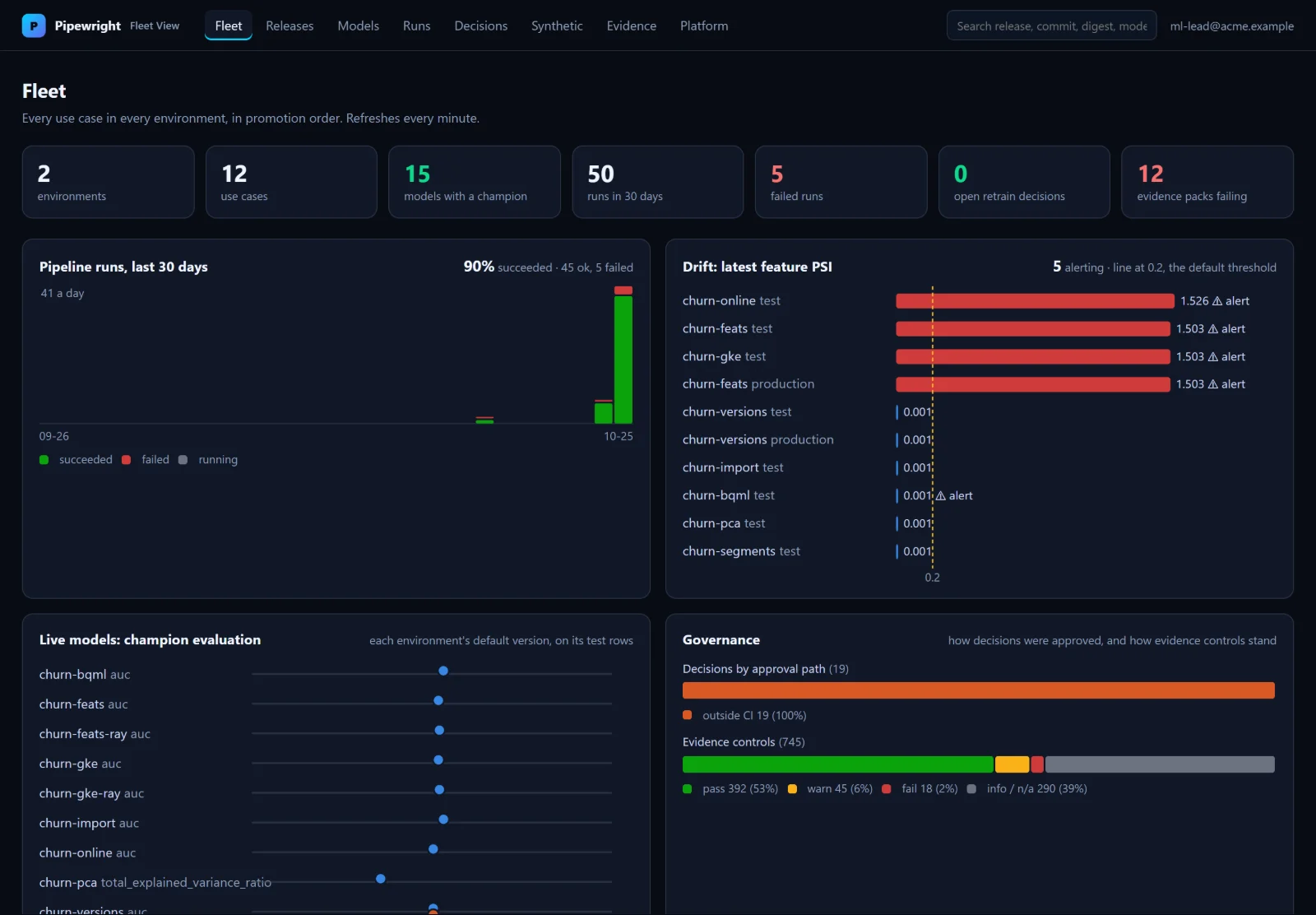
Platform teams, ML leads and model risk see the whole fleet at once: what is live where, which models wait for a decision, what drifted, what failed, and whether every control holds. Fleet View changes nothing; it shows what the platform already records.
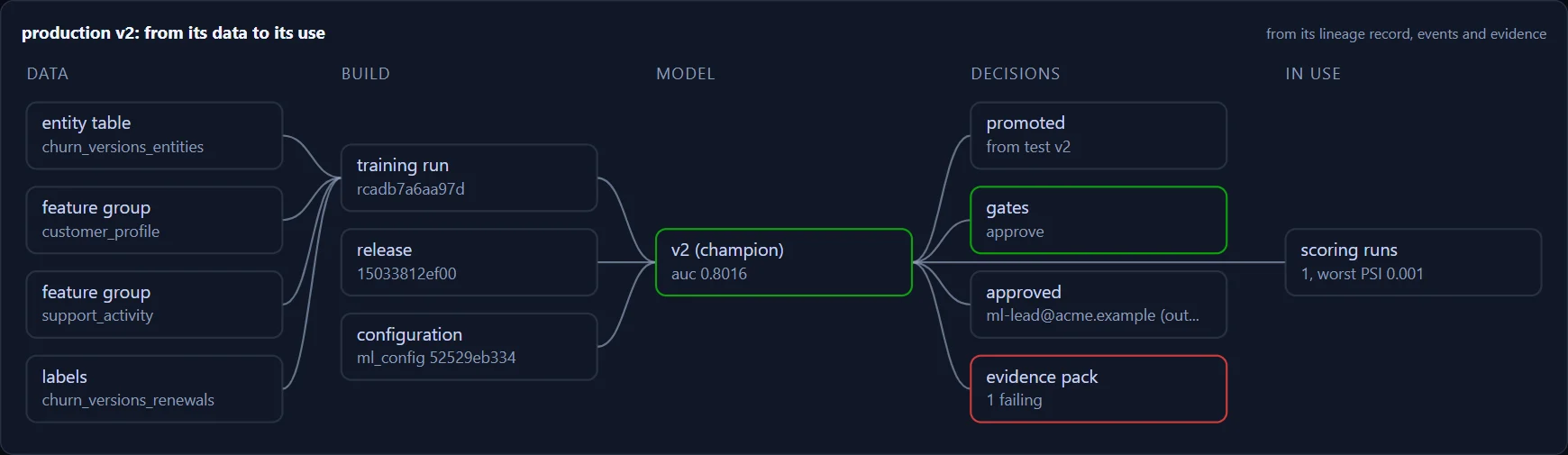
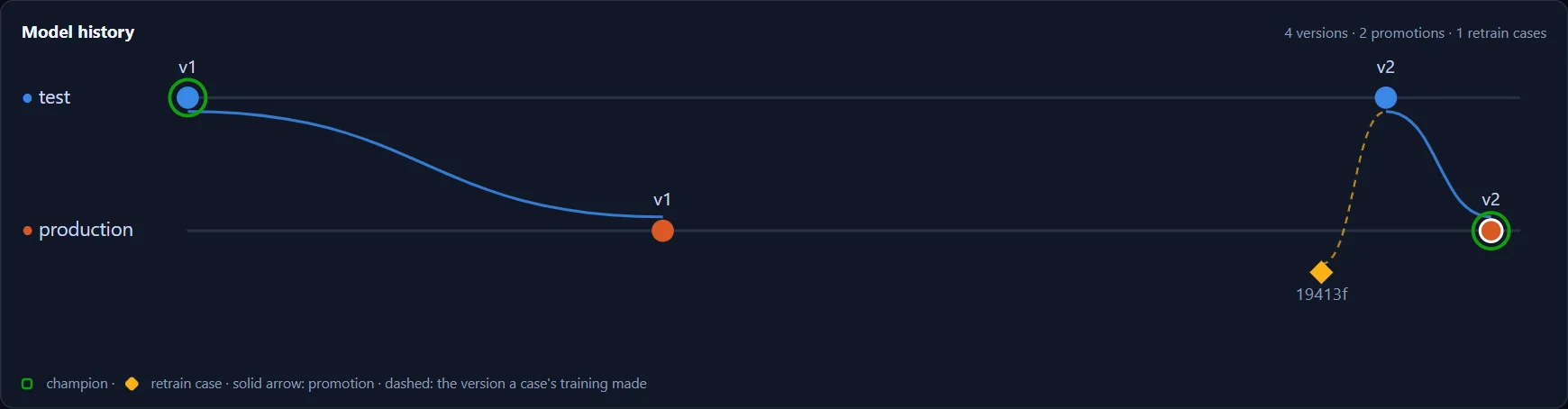
Every model’s full story, one click away.
Where did this model come from, who approved it, and what is it doing now? Teams usually answer that by digging through notebooks, tickets and consoles for days. Fleet View answers it from the records the platform writes as it runs, never assembled after the fact.

Realistic data where the work is. Released like a model is promoted.
The core learns and gates synthetic data inside the environment that holds the real data. Enterprise governs where it may go: every required approver group first, the gates again under the destination’s rules, only that run’s rows moved, and an evidence pack of seven controls, written once.
SY-01Every gate in force passedpassSY-02Generated by a released synthetic pipeline, images pinnedpassSY-03Personal data and keys never learnedpassSY-04A real holdout kept backpassSY-05Required approver groups approvedpassSY-06Only that run’s rows movedpassSY-07The source environment’s protectionpassThe people who build Pipewright, beside your teams.
The Pipewright team builds and supports it. Choose how much of the platform you want to run yourselves; your data, models and billing stay in your project either way, including your Google Cloud credits and commitments.
Platform build-out
Your environments built with you, from the blueprint, to your organisation’s policies.
First use cases live
Your first models released, monitored and decided on, side by side with your engineers.
Managed for you
We run Pipewright in your project: upgrades, patches and platform health, while you keep ownership.
Support
Agreed response times, security patches and an upgrade path you can plan around.
One core. Enterprise where it counts.
The Pipewright core is open source under Apache-2.0, on GitHub. Enterprise adds private networking, audit evidence and support from Fluxor. Both run in your own Google Cloud.
| CoreOpen source, Apache-2.0 | Enterprisewith support from the Pipewright team | |
|---|---|---|
| CLI, configuration model and examples | ✓ | ✓ |
| Shared launcher and write-once release contracts | ✓ | ✓ |
| Monitoring, alerts and lifecycle events | ✓ | ✓ |
| Retrain decisions with approver quorum | ✓ | ✓ |
| Ray on Agent Platform steps: a cluster per run, within platform limits | ✓ | ✓ |
| Promotion between environments: the tested release and approved model, by digest | ✓ | ✓ |
| Features from feature tables and Feature Store groups, point in time | ✓ | ✓ |
| Synthetic data: learned and gated inside your environment, one table or related tables and histories | ✓ | ✓ |
| BigQuery ML use cases: classification, regression, segments, PCA, forecasts and imported models 1.1 | ✓ | ✓ |
| Closed retrain loop: drift in production, retrained in test, promoted back with approval 1.1 | ✓ | ✓ |
| Online features at serving time, from the training definitions 1.1 | ✓ | ✓ |
| Serving gated in CI or automatic, GPU limits and GPU serving, scale to zero 1.2 | ✓ | ✓ |
| The decision trail: who approved, promoted and deployed each version, from the event log 1.2 | ✓ | ✓ |
| Promotion in CI, exact replays and tests before a release 1.2 | ✓ | ✓ |
| Private-managed blueprint (CMEK, VPC-SC, internal launcher) | - | ✓ |
| Approver groups, decision feeds and policy limits, provisioned | - | ✓ |
| Ray provisioned: Private Service Connect, CMEK and the identities, from one switch | - | ✓ |
| Feature governance: datasets granted per team, features required, evidence of every read | - | ✓ |
| Promotion across private projects: grants, perimeter rules, evidence it arrived unchanged | - | ✓ |
| Keyless CI into private environments: Workload Identity Federation, admitted through the perimeter by identity | - | ✓ |
| Synthetic data releases between environments: approver groups, policy per environment, evidence | - | ✓ |
| AI-assisted synthetic data settings: drafted by Gemini from a column profile, reviewed by a person | - | ✓ |
| Evidence packs and the evidence worker | - | ✓ |
| Fleet View: every environment, team and model in one read-only view | - | ✓ |
| Fleet View lineage: every model version from its data to its use 1.1 | - | ✓ |
| SIEM and observability exports | - | ✓ |
| Support, onboarding and platform build-outs | Community, or the Pipewright team on request | The Pipewright team |
See Fleet View and an evidence pack on your use case.
Thirty minutes, with the people who build Pipewright. Bring a model you need to govern.