One path from YAML to production, the same for every model.
Every ML team on Google Cloud ends up wiring the same services together: triggers, releases, identities, gates, approvals, monitoring, a record of who did what. Pipewright is that wiring, built once and tested. Your models and your data stay yours, in your project.
sha256:e4e27f97c1…sha256:7a02b6d4e8…sha256:c51f09a3b2…sha256:3d88e1f7a0…- contract valid against the schema
- templates match what was compiled
- table changes additive only
- environment policies pass
Configure
YAML, checked offline
ML teamRelease
Pinned by digest, verified
CIRun
Train, judge, score
LauncherWatch
Drift and performance
MonitorDecide
Approve, decline, snooze
PeopleProve
Evidence pack, write-once
AuditGoogle Cloud’s own services, wired the same way for every team.
The platform team builds an environment once and publishes its manifest. ML and SQL teams work only with configuration, code and the pipewright command. Every step runs in your project, as the team’s own identity.
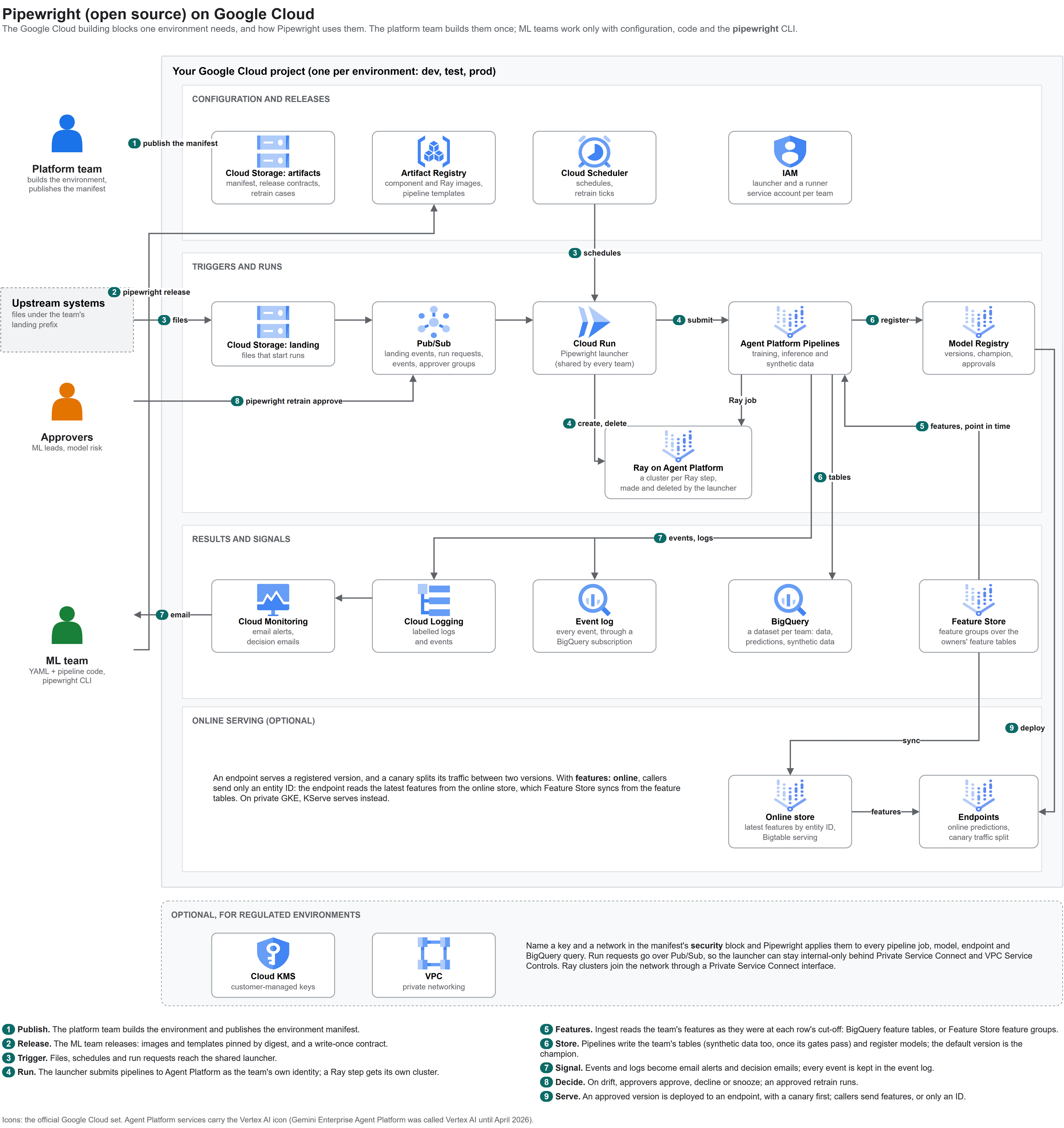
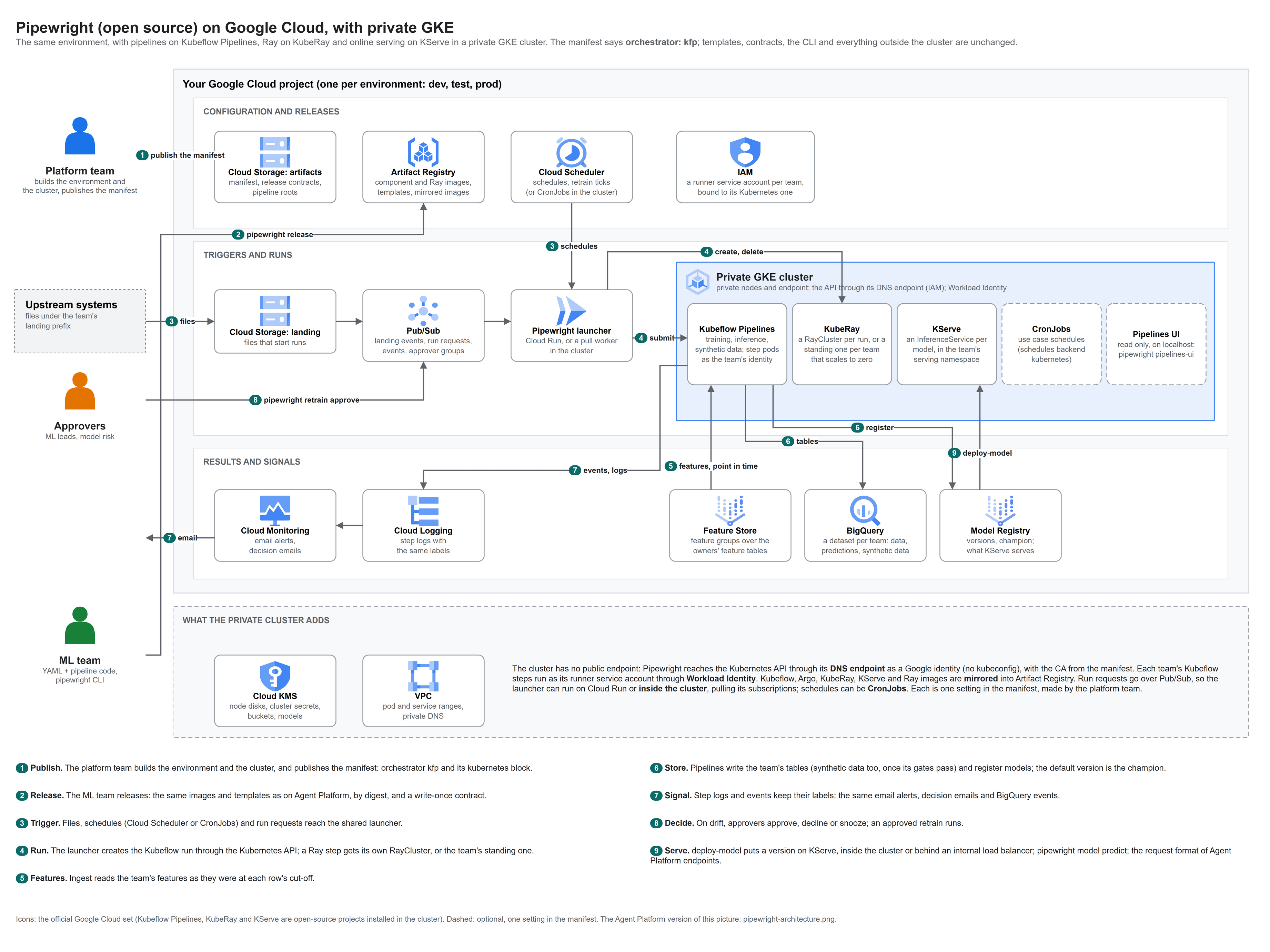
orchestrator: kfp: Kubeflow Pipelines, KubeRay and KServe run inside a private GKE cluster. Everything outside the cluster is unchanged.One platform. Four people who need it to work.
Clear ownership is the point: the platform team runs the cloud, ML teams own their models, approvers decide, auditors read the record. Nobody does someone else's job.
Describe the model. Skip the plumbing.
A use case is a folder: your pipeline code, plus YAML for data, training, gates and monitoring. Pipewright does the rest.
- Validate offline before anything costs money
- Release in one command: build, pin, verify, go live
- Champion comparison and gates on every training run
- Drift and performance monitoring with email alerts
- Features by name, point in time: from feature tables or Feature Store groups, never from the future
- Ray when a step needs a cluster: one per run, made and removed for you
- Synthetic data when you need it: one switch, learned and gated inside your environment
evaluation:
  primary_metric: auc
  gates:
    - { metric: auc, min: 0.75 }
    - { metric: calibration_error, max: 0.05 }
  champion: { enabled: true, min_improvement: 0.005 }
  slices: [contract_length_months]

$ pipewright release --env prod --usecase churn
verified: contract v3 is valid
verified: training and inference templates match
live: churn -> 67d2e88a
One environment for every team, from one file.
The starter Terraform builds an environment in one project, or Enterprise’s private blueprint builds one with every guardrail on. Teams join by name; one shared launcher serves them all, each with its own identity and data.
- One manifest per environment: the names of everything a team may use
- Limits teams cannot override: approvals, compute and GPU limits, approved base images
- Private when you need it: CMEK, VPC Service Controls and no public endpoints, with Enterprise
- CI without keys: GitHub Actions through Workload Identity Federation, let in by identity
- Policies per environment: manual promotion, required approvers
- Feature access per team: the datasets each team may read, granted, never copied
- Synthetic data rules per environment: purposes, engines, gate floors, approvers
spec:
  blueprint: private-managed
  region: europe-west2
  policies:
    promote_model: manual
    retraining: { required_approvers: [model-risk] }
  approver_groups:
    model-risk: { members: [group:model-risk@yourco.com] }
  tenants:
    retention: { landing_prefix: incoming/retention/ }
    fraud:     { landing_prefix: incoming/fraud/ }
  guardrails:
    vpc_sc: { mode: enforce }
Decide with the facts, under your own name.
When a model drifts you get a short decision pack by email. The email never approves anything: you decide with your own identity, and the record keeps your reason.
- Is it real? PSI per feature, the trend, live performance
- Is it the data? Data checks on the latest batches
- Quorum: one approval per required group, never the requester
- Snoozes expire, and cases re-open when things get worse
- Synthetic data releases wait for every required group, data protection included
Case rc-20261007-c3d3ac: churn (prod), drift
Drifted: tenure_months 3.035, monthly_charges 0.853
Data checks passed. Champion v1, 1 day old.
Approvers: ml-leads (done), model-risk

$ pipewright retrain approve --case rc-20261007-c3d3ac \
    --reason "real shift after the migration"
approve sent as approver group model-risk
recorded: case is approved
training submitted on the chosen window
The record, not a reconstruction.
Every release, run, approval and deployment is an event with who did it, kept in an event log you can query, and pipewright lineage reads a model back to its data. Enterprise adds an evidence pack per model: hashed, and stored write-once.
- Fifteen controls, each with the facts it rests on
- Gaps are reported, never hidden
- SHA-256 for every file; tampering shows
- Retention locks for years, in your project
- Synthetic data releases get their own pack: seven controls
evidence.json       controls, lineage, approvals
report.md           for people
contract.json       the release that trained it
model_card.md       intended use, limits
evaluation.json     metrics, gates, champion
events.json         every lifecycle event
audit.json          who changed or used it
SHA256SUMS          written last

12 pass · 1 info · 2 n/a · 0 gaps
A decision pack in the inbox. The decision stays with a person.
When drift or a performance drop opens a case, the people your team names get the facts in a few lines: what moved, by how much, the trend, the data checks, the champion and what retraining would use. Every step after that is sent again, so nothing is decided in silence.
retraining.decisions.notifychurn (prod) drifted, and a person needs to decide what happens next. Nothing will retrain until the required groups approve.
| Drifted | tenure_months 3.035, monthly_charges 0.853 |
|---|---|
| Predictions | PSI 1.253 |
| Trend | worst PSI 0.01, 1.04, 3.03 over recent runs |
| Performance | not judged yet: 0 labelled rows |
| Data checks | passed: 1,000 rows, most nulls total_charges 1.5% |
| Champion | version 1, trained 2026-10-06 |
| Approvers | ml-leads, model-risk |
Review the full decision pack, then decide with your own identity:
pipewright retrain show --env prod --usecase churn --case rc-20261007-c3d3ac
View case rc-20261007-c3d3ac
pipewright retrain; every decision is recorded with your name and reason. You receive this because you are in retraining.decisions.notify for churn.What you tested is what ships. Byte for byte.
pipewright promote carries a tested release, and the model you approved, from test to production. Nothing is rebuilt. Every artifact passes four checks at the border, and anything that differs from what you tested is turned back.
- release
- ca70a5d5
- model
- v5 approved
- image
- sha256:6d978a1f
- release
- ca70a5d5
- model
- v1, from test v5
- image
- sha256:6d978a1f
test sha256:6d978a1f617ef908a46d2703fe48bf51…
prod sha256:6d978a1f617ef908a46d2703fe48bf51…
identical
model files
test 6 of 6, the approved v5
prod 6 of 6, unchanged since promotion (EV-15)
verified
Turned back at the border (real refusals from our tests)
training: container.resources only in the destination. Nothing was promoted.v6 is not the default (approved) version in test: approve it there first.approvals.promote_model: auto is not allowed in prod (platform policy)Every model can tell you where it came from.
Lineage is not a project before each review: it is what Pipewright writes as it runs. A score names its model version and run; the run names its release, its image and the exact rows it read; each decision names the person who made it.
- A snapshot of what each run read, with a rows fingerprint, so a run can be replayed exactly
- Lifecycle events with who did it: releases, runs, evaluations, approvals, promotions and deployments
- An event log in BigQuery, kept by a subscription, queryable by anyone allowed to
- Structured, labelled logs for every step, routed to the tools you already use
- Erasure by key across a team’s tables, when a customer asks to be forgotten
churn-classifier v2 (prod), promoted from test v10
data      entities churn_entities, features customer_activity
          snapshot churn_snapshots · rows 45,353, fingerprint a91c…
build     release 5708ac83eaa2 · image sha256:e4e27f97…
judged    auc 0.8124 · gates pass · beat champion v1
decisions approved  by model-risk     2026-10-31 09:12
          promoted  by CI, for r.lee   2026-10-31 09:40
          deployed  by model-risk     2026-10-31 10:02
in use churn-endpoint 100% · weekly scoringRun it the way your organisation works.
Every option runs inside your own Google Cloud project: your data, models and keys never leave it. What changes is who builds and operates the platform, and how much governance comes with it.
Open source
Your team runs itThe Pipewright core under Apache-2.0. Your platform team builds the environment once; ML teams describe each use case in YAML and ship with one command. Free to use, change and extend.
- CLI and shared launcher
- write-once releases
- retrain decisions
- promotion by digest
- feature tables, point in time
- Ray, KServe on GKE
- gated synthetic data
Managed on Google Cloud
We run it, in your projectThe Pipewright team builds and operates it in your Google Cloud project, so your ML teams start on a working platform instead of building one. You keep ownership, data and billing, including your Google Cloud credits and commitments.
- environments built for you
- first use cases live with our engineers
- upgrades and patches rolled out
- platform health watched
- your teams onboarded
Enterprise
Private and governedFor regulated organisations: private by default, with the evidence auditors and model risk ask for. Everything in the core, plus the private-managed blueprint, evidence packs for every model, governed synthetic data releases, Fleet View across every environment and support from the Pipewright team with agreed response times.
- CMEK and VPC Service Controls
- no public endpoints
- private GKE
- evidence packs
- Fleet View
- keyless CI
- SIEM exports
- on premises on request
See it run in your own project.
The quickstart builds an environment, installs the CLI and releases your first use case.